

Add Heading
-
Aims
At Roselyn House School we understand that medical conditions requiring support at school can affect quality of life and may be life-threatening.
Our school will support pupils with medical conditions so that they have full access to education, including school trips and physical education.
This policy aims to:
-
Make sure that pupils, staff and parents/carers understand how our school will support pupils with medical conditions.
-
Set out the roles and responsibilities for everyone in the school community in regard to pupils with medical conditions.
-
Set out the procedure for creating, reviewing and managing individual healthcare plans (IHPs).
-
Set out how we will manage medicines in school.
-
Reassure parents/carers that the school will help their child feel safe, supported and included.
The named person with responsibility for implementing this policy is Jack Birkenhead
2. Legislation and statutory responsibilities
This policy meets the requirements under Section 100 of the Children and Families Act 2014, which places a duty on governing boards to make arrangements for supporting pupils at their school with medical conditions.
3. Roles and responsibilities
3.1 The Headteacher
The Headteacher:
-
Make sure all staff are aware of this policy and understand their role in its implementation.
-
Make sure that there is a sufficient number of trained staff available to implement this policy and deliver against all individual healthcare plans (IHPs), including in contingency and emergency situations.
-
Make sure that all staff who need to know are aware of a child’s condition
-
Take overall responsibility for the development and monitoring of individual healthcare plans (IHPs).
-
Make sure that school staff are appropriately insured and aware that they are insured to support pupils in this way.
-
Manage cover arrangements in the case of staff absence or turnover, to make sure a suitable staff member is always available, and supply staff are briefed appropriately about pupils’ medical needs.
-
Approve risk assessments for school visits and school activities outside the normal school timetable that involve provision for pupils with medical conditions.
-
Contact the school nursing service in the case of any pupil who has a medical condition that may require support at school, but who has not yet been brought to the attention of the school nurse.
-
Make sure that systems are in place for obtaining information about a child’s medical needs and that this information is kept up to date.
3.3 Staff
Supporting pupils with medical conditions during school hours is not the sole responsibility of 1 person. Any member of staff may be asked to provide support to pupils with medical conditions, although they will not be required to do so. This includes the administration of medicines.
Those staff who take on the responsibility to support pupils with medical conditions will receive sufficient and suitable training, and will achieve the necessary level of competency before doing so.
Teachers will take into account the needs of pupils with medical conditions that they teach. All staff will know what to do and respond accordingly when they become aware that a pupil with a medical condition needs help.
3.4 Parents/carers
Parents/carers will:
-
Provide the school with sufficient and up-to-date information about their child’s medical needs
-
Provide evidence of appropriate prescription and written permission for medicines to be administered by staff
-
Be involved in the development and review of their child’s IHP, and may be involved in its drafting
-
Carry out any action they have agreed to as part of the implementation of the IHP, e.g. provide medicines and equipment, and ensure they or another nominated adult are contactable at all times
3.5 Pupils
Pupils with medical conditions will often be best placed to provide information about how their condition affects them. Pupils should be fully involved in discussions about their medical support needs and contribute as much as possible to the development of their IHPs. They are also expected to comply with their IHPs.
3.6 School nurses and other healthcare professionals
Our school nursing service will notify the school when a pupil has been identified as having a medical condition that will require support in school. This will be before the pupil starts school, wherever possible. They may also support staff to implement a child’s IHP.
Healthcare professionals, such as GPs and paediatricians, will liaise with our school nurses and notify them of any pupils identified as having a medical condition. They may also provide advice on developing IHPs.
4. Equal opportunities
The school will adhere to the legal responsibilities under the Equality Act 2010 and will not unlawfully discriminate against any pupils. Our school is clear about the need to actively support pupils with medical conditions to participate in school trips and visits, or in sporting activities, and not prevent them from doing so.
The school will consider what reasonable adjustments need to be made to enable these pupils to participate fully and safely on school trips, visits and sporting activities.
Risk assessments will be carried out so that planning arrangements take account of any steps needed to ensure that pupils with medical conditions are included. In doing so, pupils, their parents/carers and any relevant healthcare professionals will be consulted.
5. Being notified that a child has a medical condition
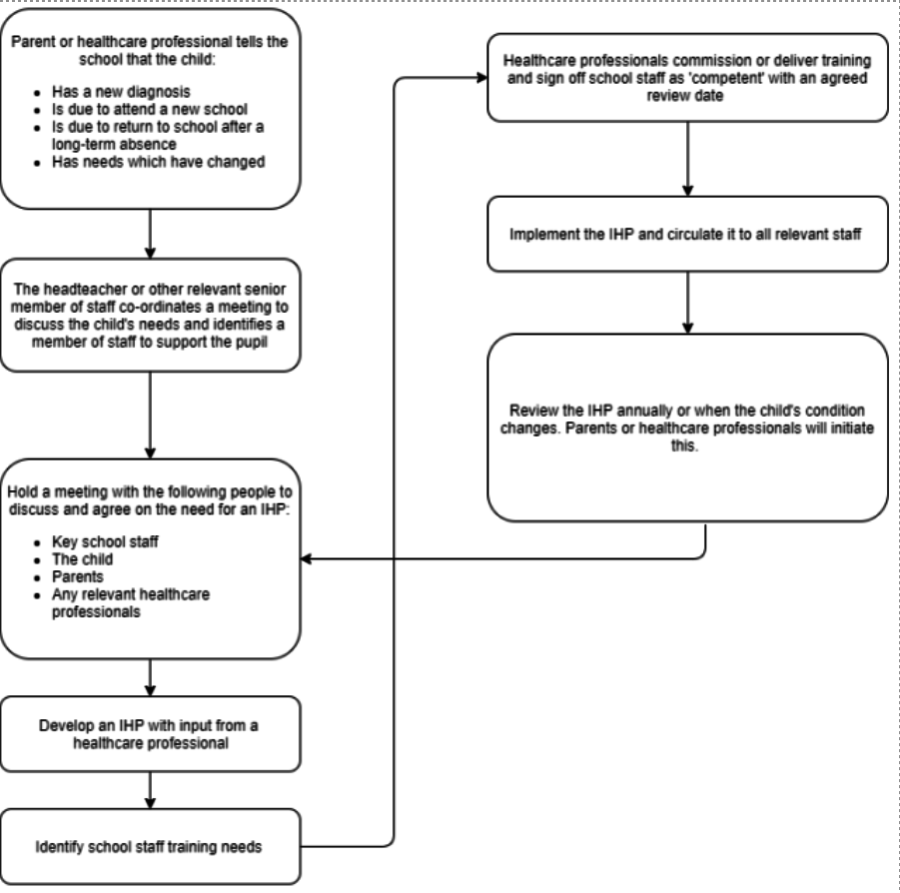
When the school is notified that a pupil has a medical condition, the process outlined in Appendix 1 will be followed to decide whether the pupil requires an IHP.
The school will make every effort to ensure that arrangements are put into place within 2 weeks, or by the beginning of the relevant term for pupils who are new to our school.
6. Individual healthcare plans (IHPs)
The Headteacher has overall responsibility for the development of IHPs for pupils with medical conditions.
Plans will be reviewed at least annually, or earlier if there is evidence that the pupil’s needs have changed.
Plans will be developed with the pupil’s best interests in mind and will set out:
-
What needs to be done
-
When
-
By whom
Not all pupils with a medical condition will require an IHP. It will be agreed with a healthcare professional and the parents/carers when an IHP would be inappropriate or disproportionate. This will be based on evidence. If there is no consensus, the headteacher will make the final decision.
Plans will be drawn up in partnership with the school, parents/carers and a relevant healthcare professional, such as the school nurse, specialist or paediatrician, who can best advise on the pupil’s specific needs. The pupil will be involved wherever appropriate.
IHPs will be linked to, or become part of, any education, health and care (EHC) plan. If a pupil has special educational needs (SEN) but does not have an EHC plan, the SEN will be mentioned in the IHP.
The level of detail in the plan will depend on the complexity of the child’s condition and how much support is needed. The governing board and the headteacher/role of the individual with responsibility for developing IHPs, will consider the following when deciding what information to record on IHPs:
-
The medical condition, its triggers, signs, symptoms and treatments
-
The pupil’s resulting needs, including medication (dose, side effects and storage) and other treatments, time, facilities, equipment, testing, access to food and drink where this is used to manage their condition, dietary requirements and environmental issues, e.g. crowded corridors, travel time between lessons
-
Specific support for the pupil’s educational, social and emotional needs. For example, how absences will be managed, requirements for extra time to complete exams, use of rest periods, additional support in catching up with lessons, counselling sessions
-
The level of support needed, including in emergencies. If a pupil is self-managing their medication, this will be clearly stated with appropriate arrangements for monitoring
-
Who will provide this support, their training needs, expectations of their role and confirmation of proficiency to provide support for the pupil’s medical condition from a healthcare professional, and cover arrangements for when they are unavailable
-
Who in the school needs to be aware of the pupil’s condition and the support required
-
Arrangements for written permission from parents/carers and the headteacher for medication to be administered by a member of staff, or self-administered by the pupil, during school hours
-
Separate arrangements or procedures required for school trips or other school activities outside of the normal school timetable that will ensure the pupil can participate, e.g. risk assessments
-
Where confidentiality issues are raised by the parent/carer or pupil, the designated individuals to be entrusted with information about the pupil’s condition
-
What to do in an emergency, including who to contact and contingency arrangements
7. Managing medicines
Prescription and non-prescription medicines will only be administered at school:
-
When it would be detrimental to the pupil’s health or school attendance not to do so, and
-
Where we have parents/carers’ written consent
The person administering the medicine will keep a written record. Parents/carers will always be informed on the same day the medicine has been administered, or as soon as reasonably possible.
The only exception to this is where the medicine has been prescribed to the pupil without the knowledge of the parents/carers.
Pupils under 16 will not be given medicine containing aspirin unless prescribed by a doctor.
Anyone giving a pupil any medication (for example, for pain relief) will first check recommended and maximum dosages for the pupil’s age, and when the previous dosage was taken.
The school will only accept prescribed medicines that are:
-
In-date
-
Labelled
-
Provided in the original container, as dispensed by the pharmacist, and include instructions for administration, dosage and storage
The school will accept insulin that is inside an insulin pen or pump rather than its original container, but it must be in date.
All medicines will be stored safely. Pupils will be informed about where their medicines are at all times and be able to access them immediately. Medicines and devices such as asthma inhalers, blood glucose testing meters and adrenaline pens will always be readily available to pupils and not locked away.
Medicines will be returned to parents/carers to arrange for safe disposal when no longer required.
7.1 Controlled drugs
Controlled drugs are prescription medicines that are controlled under the Misuse of Drugs Regulations 2001 and subsequent amendments, such as morphine or methadone.
A pupil who has been prescribed a controlled drug may have it in their possession if they are competent to do so, but they must not pass it to another pupil to use. All other controlled drugs are kept in a secure cupboard in the school office and only named staff have access.
Controlled drugs will be easily accessible in an emergency and a record of any doses used and the amount held will be kept.
7.2 Pupils managing their own needs
Pupils who are competent will be encouraged to take responsibility for managing their own medicines and procedures. This will be discussed with parents/carers and it will be reflected in their IHPs.
Pupils will be allowed to carry their own medicines and relevant devices wherever possible (KS4/5)
IHPs will include procedure for staff to follow if a pupil refuses to carry out a necessary procedure or take medicine.
-
Unacceptable practice
Although school staff will use their discretion and judge each case on its merits with reference to the pupil's IHP, they will keep in mind that it is not generally acceptable practice to:
-
Prevent pupils from easily accessing their inhalers and medication, and administering their medication when and where necessary
-
Assume that every pupil with the same condition requires the same treatment
-
Ignore the views of the pupil or their parents/carers
-
Ignore medical evidence or opinion
-
Send children with medical conditions home frequently for reasons associated with their medical condition or prevent them from staying for normal school activities, including lunch, unless this is specified in their IHPs
-
Send an ill pupil to the school office or medical room unaccompanied or with someone unsuitable (e.g. a fellow pupil who is not old or responsible enough)
-
Penalise pupils for their attendance record if their absences are related to their medical condition, e.g. hospital appointments
-
Prevent pupils from drinking, eating or taking toilet or other breaks whenever they need to in order to manage their medical condition effectively
-
Require parents/carers, or otherwise make them feel obliged, to attend school to administer medication or provide medical support to their pupil, including with toileting issues. No parent/carer should have to give up working because the school is failing to support their child’s medical needs
-
Prevent pupils from participating, or create unnecessary barriers to pupils participating in any aspect of school life, including school trips, e.g. by requiring parents/carers to accompany their child
-
Administer, or ask pupils to administer, medicine in school toilets
8. Emergency procedures
Staff will follow the school’s normal emergency procedures (for example, calling 999). All pupils’ IHPs will clearly set out what constitutes an emergency and will explain what to do.
If a pupil needs to be taken to hospital, staff will stay with the pupil until the parent/carer arrives, or accompany the pupil to hospital by ambulance.
9. Training
Staff who are responsible for supporting pupils with medical needs will receive suitable and sufficient training to do so.
The training will be identified during the development or review of IHPs. Staff who provide support to pupils with medical conditions will be included in meetings where this is discussed.
The relevant healthcare professionals will lead on identifying the type and level of training required and will agree this with the Headteacher. Training will be kept up to date.
Training will:
-
Be sufficient to ensure that staff are competent and have confidence in their ability to support the pupils
-
Fulfil the requirements in the IHPs
-
Help staff to have an understanding of the specific medical conditions they are being asked to support with, their implications and preventative measures
Healthcare professionals will provide confirmation of the proficiency of staff in a medical procedure, or in providing medication.
All staff will receive training so that they are aware of this policy and understand their role in implementing it – for example, with preventative and emergency measures so that they can recognise and act quickly when a problem occurs. This will be provided for new staff during their induction.
10. Record keeping
The Admin Team will ensure that written records are kept of all medicine administered to pupils for as long as these pupils are at the school. Parents/carers will be informed if their child has been unwell at school.
IHPs are kept in a readily-accessible place that all staff are aware of.
11. Liability and indemnity
The Directors of KS Education Limited will ensure that the appropriate level of insurance is in place and appropriately reflects the school’s level of risk.
12. Complaints
Parents/carers with a complaint about the school’s actions in regard to their child’s medical condition should discuss these directly with the Year Lead in the first instance. If the Year Lead cannot resolve the matter, they will direct parents/carers to the school’s complaints procedure.
13. Monitoring arrangements
This document will be reviewed every year, but may be reviewed and updated more frequently if necessary. It will be reviewed by Jack Birkenhead (Headteacher) and Rachel Smith (Seniour Business Manager).
14. Links to other policies
This policy links to the following policies:
-
Accessibility plan
-
Complaints
-
Equality information and objectives
-
First aid
-
Health and safety
-
Safeguarding
-
Special educational needs information report and policy
Appendix 1: Being notified a child has a medical condition
Appendix 2: Procedures for children who are sick or infectious
-
Pupils who have an infectious disease shouldn’t attend school
-
Parents should notify the school if their child has an infectious disease
-
If a pupil becomes unwell during the day – for example, they have a temperature, sickness, diarrhoea or stomach pains – the parents or carers will be contacted to collect their child
-
Pupils with a temperature, sickness, diarrhoea or an infectious disease should not attend school/nursery while they are sick. Depending on the sickness, staff may ask parents to take their child to the doctor before they return to school
-
Staff will notify parents if a risk to other pupils exists
Children with specific infectious diseases set out in the UK Health Security Agency’s exclusion table will not be allowed to return to school/nursery until the appropriate exclusion period has passed.
We will take the following steps to prevent the spread of infection:
-
Reducing or eliminating sources of infection through good hygiene practices
-
Good handwashing practice
-
Encouraging and facilitating healthy eating
-
Ensuring that regulated food hygiene standard requirements in the maintenance of food preparation areas and preparation of food are followed
-
Championing and educating staff, parents, carers and pupils on the importance of immunisation as a tool against infection (while recognising the individual’s right to choose)
 Print
Print 