

Microsoft Word document [680.4 KB]
Pathway to Adulthood Curriculum Policy and Procedures
-
Introduction
All students at Roselyn House School have an Education, Health and Care Plan. This Pathway to Adulthood Curriculum Policy has been written with due regard to how we can support our young people and their Parents/Carers with special educational needs, disabilities, learning difficulties and mental health to prepare for adult life.
Adulthood is a time of significant change for young people; especially when they have disabilities. There are many decisions and choices for young people, their families and carers to make about the future related to daily life. This can be complicated as support from education, health and social care may change when they get to 18.
This Policy has been written with reference to Preparing for Adulthood Pathway Guide- Haringey Council and The Preparing for Adulthood programme (PfA) delivered by the National Development Team for inclusion (NDTi). (The programme is funded by the Department for Education as part of the Delivering Better Outcomes Together consortium.)
-
Aims
It is our aim at Roselyn House School to build into the curriculum from Year 7 a clear Pathway to Adulthood which is introduced through all subjects we deliver and programmes of study. This will then be reflected in the Annual Review process within the school. Advice will be sought from the young person, their Parents/ Carers, Social Care, Health and other Professionals where appropriate.
The Special Educational Needs and Disability (SEND) Code of Practice 2015 states local authorities and others should normally engage directly with the young person when they turn 16, rather than their Parents. However, the young person’s family/ parents/carers should continue to be involved in discussions about the young person’s future. The young person may also ask them to help in other ways such as attending meetings, filling in forms or receiving correspondence on their behalf.
After the age of 16 young people have the right to make requests and decisions under the Children and Families Act 2014. These include the right to:
-
Request an assessment for an EHCP.
-
Make representation about what is included in their plan.
-
Request an education setting to be named in their plan.
-
Request a personal budget as part of their EHCP.
-
Appeal to the First-tier Tribunal (SEND) if they are not happy with their plan.
The local authority and school should continue to involve Parents/ Carers until the young person is 18, although the final decision lies with the young person.
Through our Pathway to Adulthood Curriculum, we aim to develop a young person and their Parent/ Carers knowledge in order to successfully prepare their way to the different stages of transition into adulthood.
In line with the PfA, we believe that young people with SEND should have equal life chances as they move into adulthood.
This should include paid employment and higher education, housing options and independent living, good health, friends, relationships, community inclusion and choice and control over their lives and support.
At Roselyn House School we aim to keep our students safe by:
Cultural Safety: An environment where their background and experiences are respected and acknowledge as valid and important. For example, they are treated with respect, kindness and curiosity. Their history and culture are considered when making decisions about the child.
Physical Safety: An environment where they are safe from being physically hurt. For example, where no-one will kick, hit, shake, drown or burn or deliberately pretends a child is ill or purposefully makes them ill.
Emotional Safety: An environment where they are safe from being emotionally hurt in any way. For example, shaming, teasing, taunting, threatening, isolating, ignoring, inappropriate expectations or silencing.
Social Safety: An environment where they can be taught how to make positive and meaningful relationships with other people. For example, key adults’ model respectful relationships with other parents, colleagues & professionals and the child has opportunities to meet and socialise with their peers and a school environment where relationships are prioritised.
(See SEAL Curriculum incorporating Mindfulness and Wellbeing Policy)
-
Preparing for Adulthood within Reviews
EHC Plans should be used to actively monitor children and young people’s progress towards their outcomes and future ambitions. The plans must be reviewed every 12 months.
All reviews and every subsequent annual review (Key stage transition) must focus on preparing for adulthood. This should include support in the following areas:
-
To find suitable post-16 pathways that lead to outcomes for employment or higher education, training opportunities.
-
To find a job and help to understand benefits.
-
To prepare for independent living, including exploring decisions young people want to make for themselves discussing.
-
Where they want to live in the future and the support they will need.
-
Local housing options and support to find accommodation.
-
Housing benefits and money matters.
-
Eligibility for social care.
-
To maintain good health and wellbeing in adulthood.
-
To plan continuing health services from children to adult’s services and helping young people understand which health professional may work with them as adults; ensuring those professional understand the young person’s needs. This should include the production of a Health Action Plan and prompts for annual health checks for young people with learning disabilities.
-
Travel support to enable independence.
-
To participate and maintain relationships in the community – including support on activities in the community.
Reviews should be person-centred, consider what is working, what is not working well and what is important to the young person and what is important for the young person as they progress towards adult life.
-
Post 16 education
At Roselyn House School, most of our Post 16 courses of study take place at our KS4/5 site. This may be Sixth Form or individualised bespoke Programmes of Learning. These courses can take place at the KS4/5 site, within the home, in the community or with Alternative Providers.
These students have a clear study plan that enables them to achieve the best possible outcomes in adult life. Roselyn House School ensures courses enable progression to a qualification or work placement that is meaningful to the student without repeating learning already completed.
Vocational work placements/ Alternative Providers ensure activities prepare the young person for healthy, independent living that supports building relationships and engagement in the community.
From the Year 11 review, a plan is stated that a young person may want to stay at Roselyn House School and move into Post 16 provision. In most cases a proposal will have to be submitted to the local authority along with explanation from local mainstream colleges as to why they are unable to meet the student’s needs.
This process will be repeated in the Year 12 review in order for a student to stay in Year 13. On occasions it may be agreed that a student can be funded for 2 years Post 16 Provision.
In exceptional circumstances a student may be granted to stay until they are 19 in order to repeat Year 13. (An example for this would be that they may have missed education due to significant hospitalisation).
-
Preparing for Adulthood Strands
It is the intention at Roselyn House School that The Adulthood Pathway Curriculum begins from year 7 and be taught through all subjects and programmes of study.
However, we are realistic in that many of our students can start at varying times in their education development and a Pathway individualised for their need will be implemented at the time of starting with us.
The strands that run through the Adulthood Pathway are:
-
Education, Health and Care (EHC) Planning and Needs Assessment
Ensuring that the EHC plan reflects the young person’s aspirations and long-term goals, with outcomes and support designed to prepare them for adulthood.
-
Employment, Education and Training
Supporting young people to move into paid employment, apprenticeships, or further and higher education, and to develop the skills, qualifications and experiences needed for work.
-
Independen Living
Developing the knowledge, confidence and practical skills to live as independently as possible, including exploring housing options, managing finances and daily living tasks.
-
Friends, Relationships and Community Inclusion
Promoting positive relationships, friendships and social connections, and enabling young people to play an active role in their local communities.
-
Health and Wellbeing
Supporting young people to be as healthy as possible in adult life, to manage their own health needs, and to access appropriate adult health and social care services.
-
Friends, Relationships and My Community
Students will learn:
Key Stage 3:
-
How to develop and maintain a variety of healthy relationships within a range of social/cultural contexts and to develop parenting skills.
-
How to recognise and manage emotions within a range of relationships.
-
How to deal with risky or negative relationships including all forms of bullying (including the distinct challenges posed by online bullying) and abuse, sexual and other violence, and online encounters.
-
About the concept of consent in a variety of contexts (including in sexual relationships).
-
About managing loss including bereavement, separation, and divorce.
-
To respect equality and be a productive member of a diverse community how to identify and access appropriate advice and support.
Key Stage 4/5:
-
Personal Action Planning.
-
Drugs Education.
-
Sex and Relationship Education.
-
Personal Finance.
-
Emotional Wellbeing.
-
Healthy Lifestyles.
-
Making Informed Career Choices.
-
Applying for Jobs and Courses.
-
Relationships, Behaviour and Practices in the Workplace.
-
Personal Safety (physical, emotional, and online).
-
Being a Critical Consumer.
-
Introduction to Diversity, Prejudice and Discrimination.
This will be co-ordinated by a lead with tracking produced to feed into reports. There will also be AQA Units designed to be achieved by students. The aim will be to promote student wellbeing, resilience, confidence, develop interests, understand what local facilities are on offer, promote appropriate and sustainable friendship groups. It will look at if the family requires further support which then can be requested and dealt with for CLA or Safeguarding Leads.
-
Good Health
For all Key stages, work will be done with school nurses, GP, CAMHS and Social Care and advice will be sought for Annual Review process.
Students will learn about Healthy Eating, fitness, GP and Health checks as part of the PSHE curriculum and through Physical Education and Science lessons.
Students will be introduced to the concept of a lifestyle that constitutes being healthy is one which you:
-
Take part in physical activity.
-
Eat a balanced diet.
-
Avoid harmful substances such as drugs, smoking and alcohol.
-
Sustain friendships.
They will explore:
Social benefits of exercise are those which:
-
Develop teamwork and cooperation.
-
Overcome challenges in a team against the opposition.
-
Increase your self-worth.
-
Meet new people and make friends.
Physical benefits of exercise are those which:
-
Increase your life expectancy.
-
Improve muscle tone and posture.
-
Strengthen bones.
-
Improve flexibility and cardiovascular fitness.
-
Makes you look good and feel good.
-
Burns off stored fat.
Mental benefits of exercise are those which:
-
Relieves stress, tension and aggression.
-
Provides excitement and enjoyment.
-
Improves self-esteem and confidence.
-
Develops a sense of being part of something.
-
Provides opportunities for success.
-
Allow you to forget life’s problems.
-
Developing Independence
At Roselyn House School we aim to support students but lead them on a path to independence by developing confidence in their selves and their abilities as a learner.
Opportunities are provided in Key Stage 3 for independent learning and are further established at Key stage 4 in participating in vocational activities which may include Alternative provision.
The PSHE Curriculum will allow for students across the key stages to develop understanding of Housing, benefits, money, NI and Tax, Bank Accounts, Personal budgets, finance, independent living skills. This is further enhanced by the Enterprise and Employability and Life Skills Curriculum.
There will be some cross over for independent travel with Friends, Relationships and my Community. Students may complete AQA Units for PSHE and Level 1 Award/ Certificate in Employability and in addition Level 1 Award/ Certificate in Enterprise.
This will be co-ordinated by a lead and schemes of work available for all teachers to access.
(See Personal, Social, Health and Economic Education and Spiritual, Moral, Social and Cultural Development Policy)
-
Preparing for and finding employment
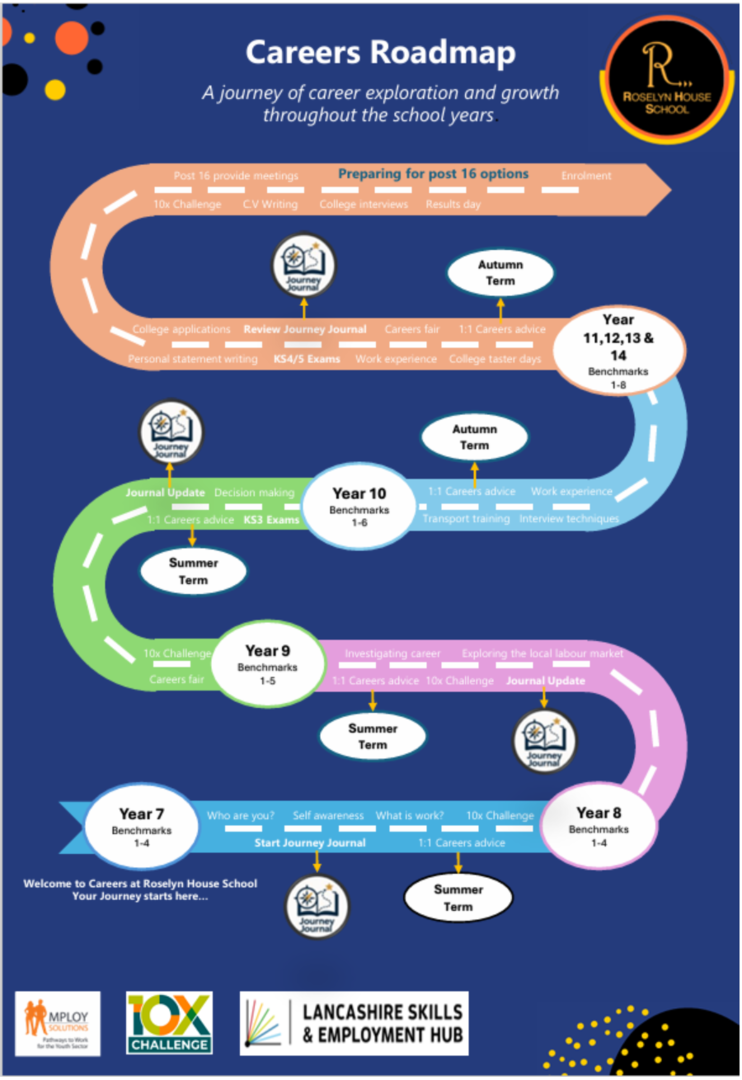
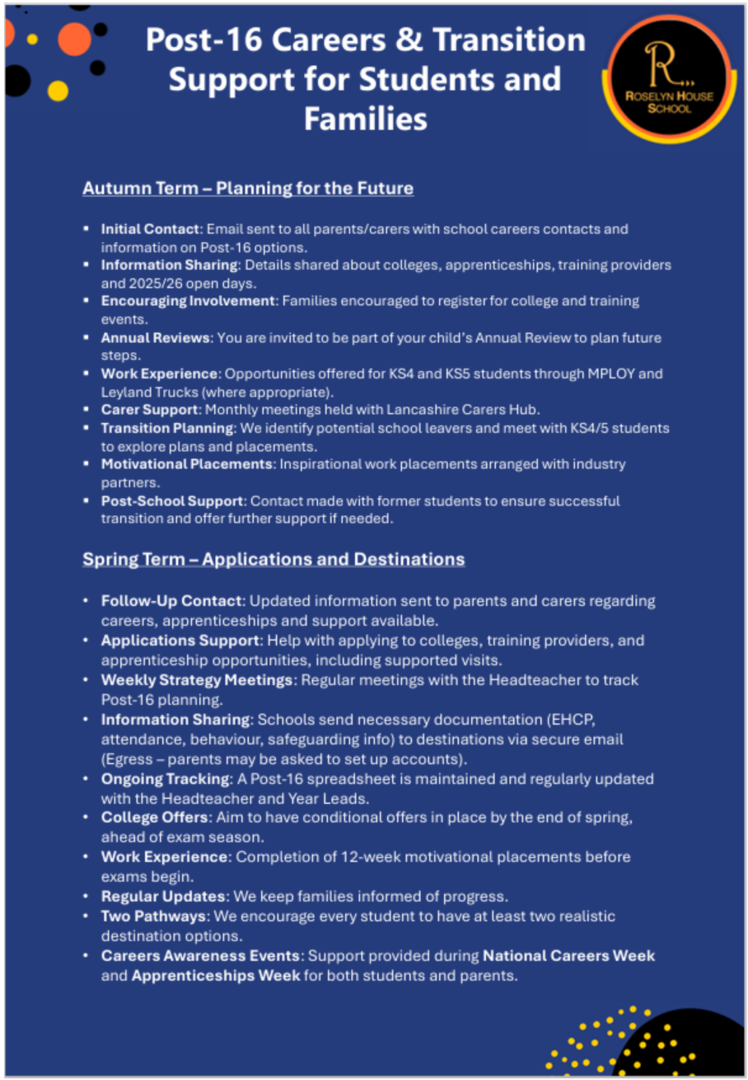
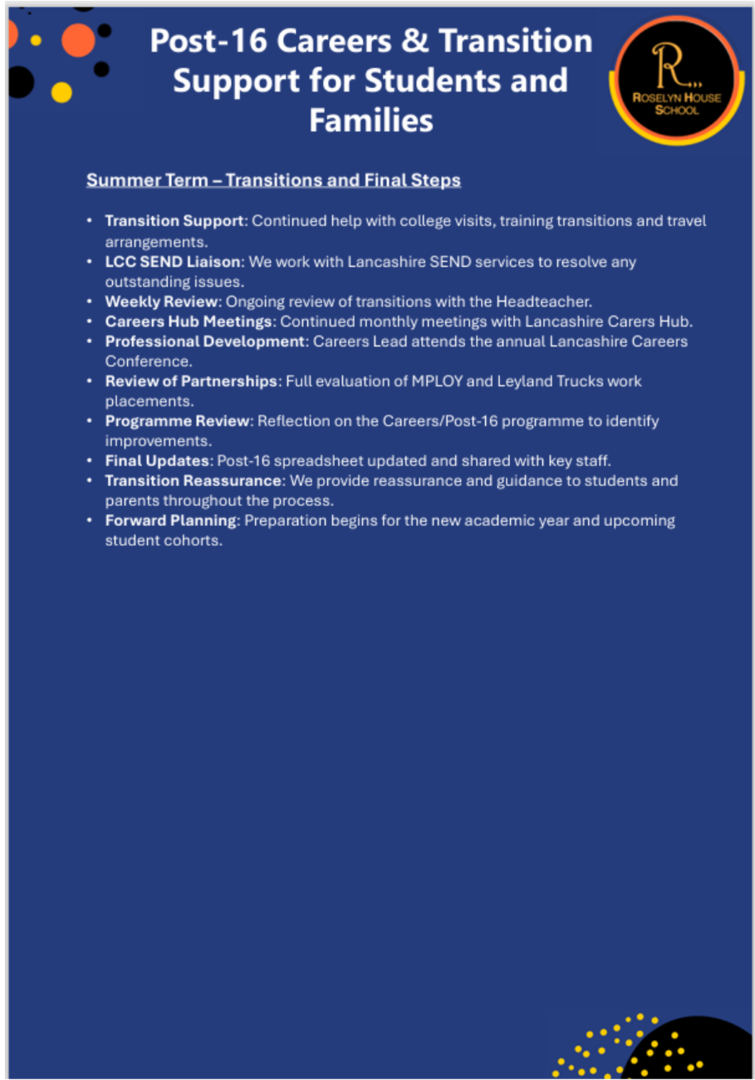
Where appropriate planning for a Career Plan or Vocational Profile will begin in Year 7. This will follow the students formal or informal Pathway. This will be tracked and followed on the student’s journey journal, careers roadmap working from the post-16 careers and transition support. Please see below:
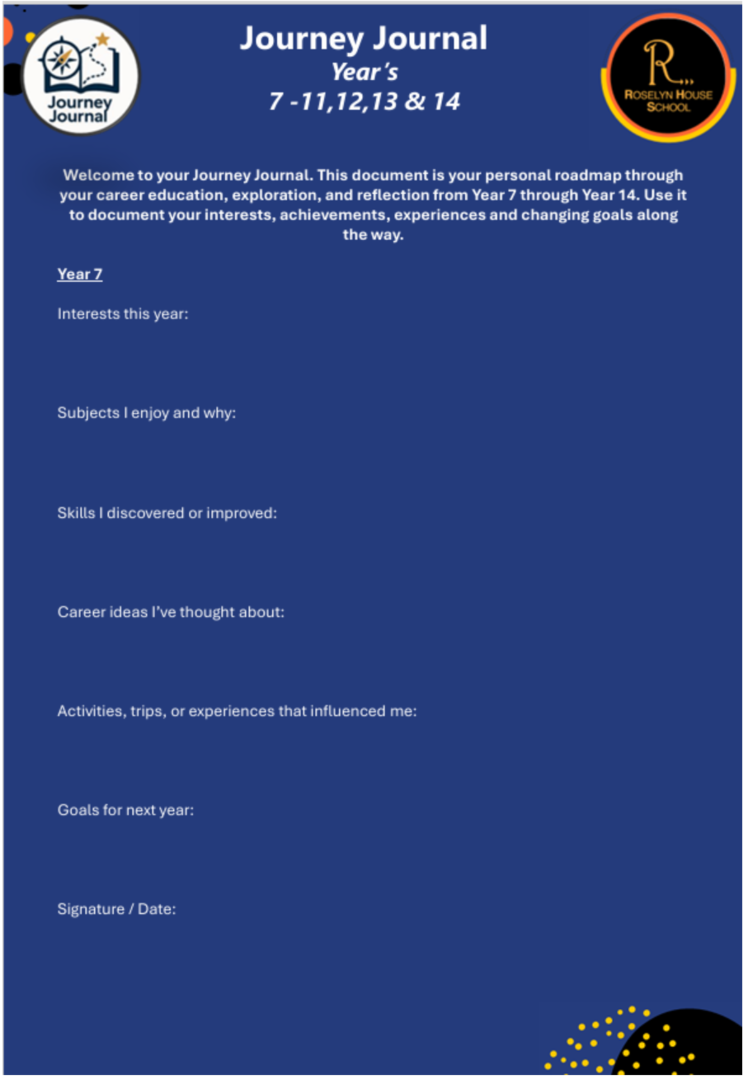
Independent travel will be further discussed and if it is feasible to be achieved by the student. Personal Budget and Direct Payment or other funding will be discussed if it is available to support employment. This will also include students who stay on, post 16 where proposals for Year 12 will be submitted to the authority.
The career and vocational plan across each stage will continue to be updated and all possible options will be explored in employment, education and training. Students may be able to apply for ESA.
At the end of Year 13, students should have been supported to Transition into a new education/ training placement or employment.
This will be co-ordinated by careers/ vocational Lead across all school. This will be monitored. If a student is not able to continue to access their chosen transition pathway, further support may be offered past their time at RHS.
The Adulthood Pathway Curriculum is strengthened through Roselyn House Outdoor Curriculum, including Duke of Edinburgh. (See RHS etc and Outdoor Curriculum rationales).
-
Preparing for Transition through Adulthood Pathway Strands
Roselyn House School through systems of tracking, monitoring and assessment develop an understanding of each of our students and their individuals. This along with contributions from staff who work closely with them forms a fully rounded assessment of Adulthood Pathway needs.
It is important that this Policy is explained to staff and students and is worked on in collaboration with individual needs. Training is provided for staff and specific Leads are designated for each strand.
We want our young people to overcome many barriers that they may have had along the way to becoming an adult and to achieve the best that they can for their selves. We encourage friendships, support and understanding of own and others’ needs, welcome community activities, the importance of leading healthy lifestyles and developing as an individual in order to live in society as a positive citizen.
Roselyn House School and family members support young people to acquire independent living skills such as travel training, basic cookery skills, personal care and money management. Moving away from home is a huge step and should be thought through carefully.
We promote positive and supportive relationships among our school community and introduce our young people to activities outside of school. It is important that young people maintain friendships after school ends. Local community centres, libraries, youth clubs, churches, galleries, cafes and schools offer a range of daytime and evening events and activities to help make new friends. These range from dance classes, music, singing as well as Scouts, Guides, art and pottery. Information is publicised on noticeboards and the internet.
We encourage students to attend their meetings and make their own decisions where possible and to seek out advice from others.
-
Ceasing an Education, Health and Care Plan
A local authority can cease to maintain an EHC Plan if it determines that it is no longer necessary for the plan to be maintained if:
-
The young person has taken up paid employment (excluding apprenticeships).
-
The young person has started higher education (university).
-
A young person aged 18 or over has left education and no longer wishes to engage in further learning.
-
The young person has turned 25.
-
The child or young person has moved to a different local authority.
-
The young person has met their outcomes as specified in their plan.
The Local Authority will do this by issuing a “cease to maintain notice” in writing to the parent or young person, stating the reasons why, after consulting with the young person/ their parents/ carers and Head teacher/ Deputy Headteacher. The young person can appeal if they disagree with the Local Authority’s decision.
-
Continuing Support After Leaving Roselyn House School
We continue to monitor students who have left and in some circumstances support the student on a voluntary basis. This can range from home visits, taking to placements/ activities, providing drop in, contact via email.Further procedures are available for Year 14 and 19-25 by request.
-
Monitoring Arrangements
This document will be reviewed every year, but may be reviewed and updated more frequently if necessary. It will be reviewed by Mr Jack Birkenhead (Headteacher) in consultation with the wider school community.
-
Linked Policies
This policy operates in conjunction with the following school policies:
-
Curriulum policy
-
Outdoor Education policy
 Print
Print 